Sustainability isn’t one line on a survey – it’s a range of attributes, behaviours and ways of living that consumers may not even consider as ‘sustainable.’
Critics say sustainability isn’t a real decision driver: ask consumers if it’s important and they don’t behave as if it is (the say-do gap); ask them to rank what matters and it falls down the list (the attribute trap). But that treats sustainability like a single item when it’s more complex than that. Sustainability underpins people’s decisions and actions through a range of attributes, behaviours and ways of living that consumers may not even consider as ‘sustainable.’ Once you look past the single line on the survey, the research tells a different story.
Sustainability is the way of the future
People’s consideration of sustainability when they buy, bank and work has not changed since 2021: 76% considered a brand’s social and environmental actions when making a purchase, 63% when choosing where to bank and 56% when choosing their next workplace.1
About 2 in 3 Australian consumers think that sustainability is the way of the future, rather than a fad. And that sustainable future is the responsibility of manufacturers and governments.2
With the say-do gap potentially accounting for 40 percentage points9, there is a lot of opportunity to close the gap – manufacturers making more sustainable products and services available at a reasonable price without compromising functionality and aesthetics, and building awareness and understanding; and governments supporting sustainable behaviours and purchases with policies and legislation.
But the opportunity is greater than that. Sustainability has gone beyond a single line item of consideration to be embedded in everyday purchasing criteria and behaviours to our way of living. Just as organisations are working to understand the multi-dimensions of sustainability across the value chain, so too we need to understand the multi-dimensions of sustainability with our consumers, that may or may not be consciously sustainable to them.
Embedded in everyday purchasing criteria and behaviours
When asked the most important criteria for making day-to-day purchases, sustainability ranks lower on the list (28%), behind price (89%), product quality (74%), familiarity with the brand (49%), convenience (42%), reputation of the brand (37%), where its produced/manufactured (37%) and product appearance (31%).2
But look beyond that one stat and the everyday purchasing criteria are strongly related to the four sustainability factors that people consider most important: durability (89%), repairable or fixable (70%) are related to price, product quality, convenience and reputation; locally produced (63%) and ethically produced (62%) are related to price, product quality, reputation and where its produced/manufactured.3 This is what we refer to as the attribute trap.
Sustainable behaviours are becoming part of people’s everyday behaviours and lives, with 97% of Australian shoppers engaging in at least one or more sustainable practices in the last 3 months, and most who engaged said they do so frequently – but it’s not just about environmental or social sustainability. Bringing their own shopping bags (79%), recycling (61%), buying locally sourced/produced (43%), riding bike/taking public transport /car-pooling (42%) and reducing the amount of new products bought (36%) all have cost benefits and for some, social benefits.
Roughly 1 in 3 households now has rooftop solar, with the benefits of saving costs as well as the environment.4
Categories where sustainable products are purchased always/often are those where manufacturers have made sustainable products that perform functionally, are physically available and at a reasonable price: paper products (50%), baby products (47%), cleaning products (46%), food/kitchen storage products (43%), personal care/beauty products (42%), pantry/fridge essentials (40%).2
More importantly, the multi-dimensions of sustainability provide emotional benefits. In research we conducted, these categories have greater impact on human wellbeing – they go in our bodies, on our bodies and in our home environment – as well as environmental health.10
We’re seeing fashion/apparel and soft furnishings start to move in this direction for the same consumer reasons – it’s now up to manufacturers and retailers to meet the demand.
Electrified vehicles have been slow on both sides: consumer uptake, and manufacturers not yet meeting demand for functionality, price and physical accessibility, as well as the performance and design choices that express identity. They are now increasing more than before, up 38.7% in 2025 to be 13.1% of new car purchases.11
So far, sustainability has shown up in what people buy and do. What’s next is bigger: the multi-dimensions of sustainability embedding in ways of living that consumers may not even consider as ‘sustainable.’
Embedding in everyday lives of mainstream consumers
For some leading edge and early adopter consumers, sustainability has been a conscious values-driven choice from the start, providing emotional and social benefits.
On the other end, functional benefits underpin criteria such as durability and repairability for mainstream consumers – saving time and money, particularly driven by the cost-of-living crisis.
What’s happening in between is an expansion of emotive platforms across the multi-dimensions of sustainability infiltrating mainstream – wellbeing being one of them – with many not obviously sustainable.
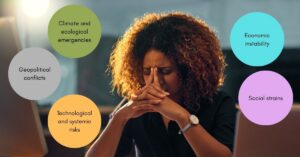
In the current macro environment, people are deafened by the meta-crisis, drained by dopamine culture and deprived of trust. Living this way is extractive, depleting and debilitating – it’s not sustainable. So, sustainability takes on new meaning. It’s no longer just about an organisation’s social and environmental actions to meet today’s needs without compromising those of future generations. It’s about ways of living that put more back in than they take out. It’s about individual, collective and systemic wellbeing, thriving, flourishing, unleashing potential with social foundations met for all and planetary boundaries respected.
Take GLP-1, for example. Cynic or not, its individual, collective and systemic benefits are well-versed. Helping people eat less and healthier options leads to greater wellbeing of the individual, which reduces the burden of disease on the health system and economy, and reduces food consumption and waste which is one of the biggest sources of emissions.
The same logic applies to the return to slow living. In response to the Dopamine Culture, people are returning to slow, traditional culture – playing sport instead of gambling sport, home cooking instead of uber eats, vinyl records instead of trending sounds.6 Less stress, greater social connection, healthier choices for individuals to thrive in life. Reduction of systemic issues of gambling, obesity, loneliness and inadequate pay for artists.
Consumer forecasters are already tracking where this leads. Every year WGSN identifies their future consumer archetypes5 – which notably are not fixed segments, rather people dip in and out of depending on their current context. Two of the significant ones for 2028 are particularly relevant for this conversation:
- The Restorers are “Calm and sensory-aware, … reclaiming balance and authenticity in a world that feels accelerated and overstimulated.” Sustainability is an extension of the way they live, more intentional and conscious. They buy less but better, made to last and recyclable. They seek products that are made or sourced locally, durable materials, natural ingredients. The energy of the brands needs to be slower and peaceful.
- The Keepers. Discerning, research-driven consumers seeking stability, trust and permanence in a world where institutions feel increasingly unreliable. Sustainability simplifies their life, buying once rather than often. They’re looking for durability and repairability. And they want safety, identity and data protection.
Calm, balance, safety and stability are ways of living that put more back in than they take out, within which sustainable purchasing criteria and behaviours are embedded. This is where organisations need to spend more time thinking about people’s lives and the role sustainability may play, consciously or not.
From Sustainability to Sufficiency and Regeneration
For organisations that are ready to push beyond “net zero” impact, there is a consumer need as well as social, environmental and prosperity needs.
Rising inequality is driving overconsumption. As affluent people consume more products, services and resource-intensive lifestyles, lower income are driven by status anxiety and social comparison to consume more. The pursuit of status through material wealth creates a culture where sustainable practices, like reducing consumption or recycling, are undervalued.7
In response to the Dopamine Culture and cost of living crisis, we found people are seeking permission to take the foot off the consumption pedal and not have to keep up with the Joneses. It is showing up in social media as overconsumption core, de-influencing, project pan and minimalism. Chasing more doesn’t make people happier, instead the concept of ‘sufficiency’ gives them a sense of relief and freedom to focus on more sustainable, restorative and regenerative activities that give them safety and serenity, abundance and flourishing, like those in the sections above. 8,12
With all the good intentions to become more sustainable, few organisations address overconsumption. To thrive in the next phase of sustainability, organisations need to shift thinking, and emotive platforms, from excess to sufficiency (“enough”), social comparison to social cohesion, from sustainability to restoration and regeneration.
What This Means for Marketing and Business Leaders
When understanding consumer desire for sustainability, I think we can safely say it’s there, in one way or another.
As the broader, multi-dimensional definition of sustainability becomes more prevalent and relevant, it is increasingly harder to separate sustainability from other factors – especially from isolated facts and survey questions versus qualitative research, ethnography and behavioural economics with analysis that uncovers connections and joins the dots.
We are operating in an ecosystem of interconnected factors and sustainability ultimately underpins them all.
Sustainability should continue to be embedded throughout the organisation, integrated through business, brand and employer brand strategies and stakeholder value propositions.
Most organisations are taking sustainability to market through functional attributes and claims, serving conscious consumers and using surveys to understand isolated purchasing criteria and behaviour.
For sustainability to reach everyday mainstream, it needs to be embedded in everyday purchasing criteria, behaviours and ways of living.
The work that needs to be done now is:
- Building trust – clarity and understanding of functional attributes and claims, transparency and authenticity in social and environmental impact
- Physical availability – distributed in main retailers, reasonable price, noticeable on shelf
- Mental availability – a broad range of category entry points and an emotive platform in which sustainability is embedded but go beyond the obviously ‘sustainable’
This requires qualitative research, ethnography, behavioural economics and analysis to understand and join the dots between the dimensions of purchasing criteria, behaviours and ways of living.
The brands that thrive in the future won’t be the ones claiming to be sustainable. They’ll be the ones already woven into how people live.
—
The Healthy Brand Company delivers research and strategy at the intersection of brand, employer brand and sustainability – helping organisations build and align the promise and experience that is relevant and compelling to all stakeholders.
We’re founding members of The Regenerative Business Collective – a global network of specialists helping organisations and brands find new ways to create value that embrace sufficiency, restore and regenerate people, planet and prosperity for all.
If you want further information, contact Rachel@thehealthybrandcompany.com
Sources
- Confusing Or Convincing Report, South Pole, 2025
- Australian Consumers’ Sustainability Study, Research Ink, 2024
- CRS Retail Sustainability Spotlight, Monash Business School, 2025
- Rooftop Solar and Storage Report, Clean Energy Council, July–December 2025
- Future Consumer 2028, WGSN, 2026
- DOSE, TJ Power, 2025
- The Spirit Level At 15, Professors Richard Wilkinson and Kate Pickett with Equality Trust, 2023
- Insights on Regeneration and Sufficiency, The Regenerative Business Collective, 2025
- The Elusive Green Consumer, Harvard Business Review, 2019
- World of Wellbeing, The Healthy Brand Company, 2022
- EV Sales Hit Record Highs in 2025, electricvehiclecouncil.com.au, 2025
- The Psychology of “Enough”. Why Chasing More Doesn’t Make Us Happier, Rebecca Bridger, 2025
- Image source: File ID 26097222 | © Minyun Zhou | Dreamstime.com