Look for research on what employees want from their workplace and much is based on the internal drivers of the employee experience, such as work/life balance, training and career opportunities, culture and work environment, safety and wellbeing, salary and benefits.
Few consider the external environment.
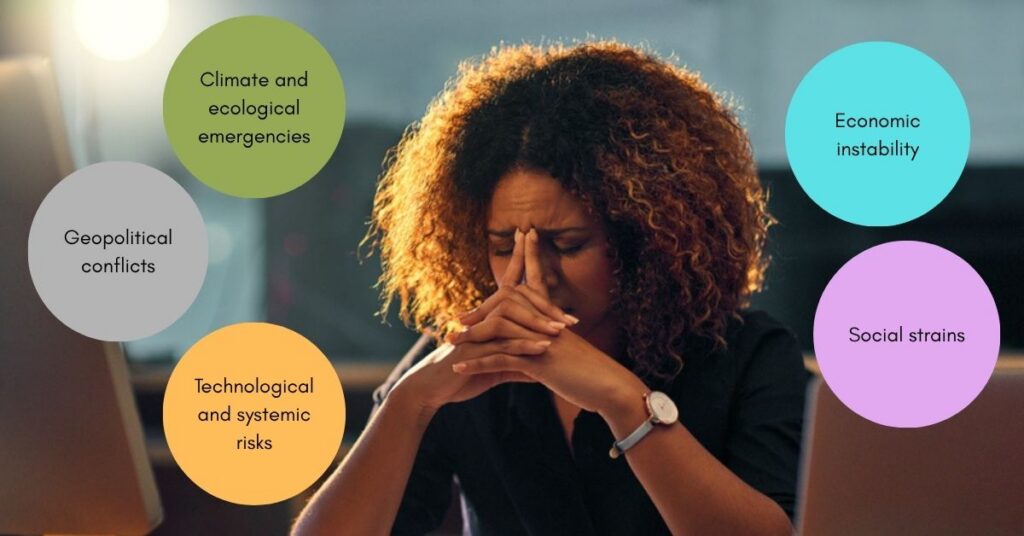
But employees are people, and people are impacted by the polycrisis – that crazy entanglement of interconnected crises locally and globally that have a multiplier effect on each other:
-
- Climate and ecological emergencies – global warming, severe weather events, environmental degradation, biodiversity losses
-
- Geopolitical conflicts – political instability, armed conflicts and wars (eg Ukraine, Middle East)
-
- Economic instability – cost of living, inflation, energy shortages, economic inequality
-
- Social strains – global pandemics, immigration, erosion of democracy
-
- Technological and systemic risks – data security, artificial intelligence, misinformation
It brings a lot of volatility, uncertainty and complexity from the outside that builds on what’s already happening on the inside – pressures to grow, reduce costs, improve efficiency and productivity, organisation transformation and leadership changes, AI implementation, diversity and inclusion changes.
It brings a lot of ‘always on’ noise and stimulus, dopamine culture and lack of focus, trust and social cohesion issues and sense of grievance.
And it shifts the emphasis on people’s values and what they need and want from their workplace.
A Workplace Report from the Change Lab indicates that 55% of Australian workers are quietly cracking, experiencing significant internal distress. While maintaining expected performance, workers who are often cracking show dramatically reduced thriving scores and are 6.2 times more likely to experience clinical burnout than those who aren’t.
They identified that 67.3% of cracking is driven by the external factors – these were the polycrisis factors they measured – led by cost of living 41.7%, with social division 10.1%, climate change 8.4% and political unrest 7.1%. Workers feel unable to discuss these external pressures at work or that employers cannot address them – which is why they’re quietly cracking, masking the impact of external pressures while maintaining performance. Job security fears account for 19.7% – some of this is driven internally such as organisation change and AI implementation, some externally from industry transition and economic instability. In comparison, AI tool introduction accounts for 5.8% – not insignificant, but gaining most of the focus on its impact on the organisation and its employees.
The report offers solutions for organisations to support workers including integrating workplace wellbeing, psychosocial and psychological safety; leading with HEART – Honouring each other’s feeling; Engaging purposefully in conversations; Appreciating strengths; Reaching out for help; and Taking tiny steps forward together; and change scaffolding to consistently maintain transparency of internal changes.
Dr John P Kotter has also highlighted the polycrisis in his insights on leadership for an uncertain world. He explains that these real and perceived threats trigger our instinctive fight-or-flight response, and when employees can’t resolve the threat either way, it can tip into a freeze response, leaving people overwhelmed and organisations at risk of paralysis. As he puts it, “the last thing you want in an increasingly volatile, fast moving and turbulent world”.
His solution is mobilising the workforce, so that employees at the edges of the organisation are identifying and acting on changes in context, addressing real problems or taking advantage of real opportunities, in real time.
Edelman’s Trust Barometer found that 60% worry about international trade and tariff conflicts hurting the company they work for; and 54% worry about losing their job as a result of the recession.
So how does this impact your employer brand?
Suffice to say, people are aware of the impact the polycrisis has on them and their organisations. But as the Change Lab identified, they don’t feel they can discuss it with their leaders or that the organisation can do anything about it. Not only does it mean they’re “quiet cracking”, it also means its unlikely to spontaneously come up in research for the employer brand and EVP, unless specifically probed.
Given that one third of our life is spent at work; that “my employer” is the most trusted organisation by 79% of respondents and “my colleagues” and “my CEO” are among the most trusted people (Edelman Trust Barometer 2026); and that the impact of the polycrisis on people and organisations is at crisis-level severity. It would make sense that people would be interested in understanding how organisations are managing the risks and opportunities of the polycrisis and specifically how they are helping their people cope with polycrisis uncertainty.
Organisations that want to have thriving employees and be seen as future-facing, human-centric and driving sustainable growth need to have the policies and practices in place for their people to adapt to the external changes, as individuals and as the organisation.
This is key to your employer brand, because your employer brand is not just a candidate journey or campaign for recruitment. It encapsulates what makes your organisation a great place to work where current and future employees can thrive. Your employer brand is what attracts, retains and engages the people your organisation needs to deliver the business strategy and brand-customer experience. Therefore, how your organisation manages polycrisis uncertainty for individuals and the organisation as a whole needs to be designed for and communicated to current and prospective employees as part of your employer brand, employee value proposition and employee experience.
Actions to take
1. Understand how the polycrisis impacts your organisation and how your organisation addresses this in its risk and other strategy frameworks.
2. Understand how the polycrisis impacts your current and prospective employees.
3. Develop the policies and practices for your people to thrive in polycrisis uncertainty.
4. Determine how this impacts your employer brand, employee value proposition and employee experience, adapt and evolve accordingly.
If you’d like an objective third-party perspective on the polycrisis and its impact on your people, employer brand, EVP and EX, please contact rachel@thehealthybrandcompany.com.
—
The Healthy Brand Company delivers research, strategy and planning at the intersection of brand, employer brand, business and sustainability.
We engage with current and prospective employees to develop the employer brand, employee value proposition and employee experience that attracts, retains and engages the people to deliver the strategic plan and brand customer experience.
—
Sources:
-
- Workplace Report, The Change Lab, 2025
- Trust Barometer, Australia, Edelman, 2026
- Leadership for an uncertain world, Dr John P Kotter, 2025 (https://www.kotterinc.com/leadership-for-an-uncertain-world/)
- Image ID 320198220 | And © Yuri Arcurs | Dreamstime.com, adapted